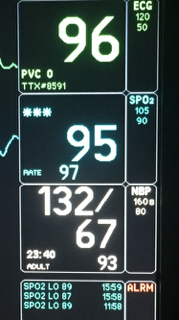
Countless others have written of the injustices faced by those lucky enough to be patients in the developed world in 2014 (as opposed places like West Africa where hospital systems are severely lacking). Some of the pain points for patients surround access to care in the first place, being asked to answer/fill out the same questions repeatedly, insanely high out-of-pocket expenses, abyssal coordination between providers, misinformation on prognosis, and confusion about end-of-life care. In addition to all of this (and much more)– as an internal medicine doctor who works mainly night shifts in a hospital – I have noticed one thing that has not improved for patients is the uncertainty of their day. I try my best not to cringe when patients ask me what time exactly they will be going for their CT scan (or other test/procedure, or when will Doctor A. see them in the morning). Unfortunately, in the majority of cases I have no idea.
It pains me most to see patients awaiting a diagnostic test or invasive procedure who are kept NPO (nil-per-os; not allowed to eat or drink). Hunger and thirst aside, even the ones that aren't NPO are understandably anxious. Sometimes they endure this torture; only to have the test canceled at the last moment. “You know that emergent cases take precedence” is the variation of response that is often barked at me when I call other departments for answers. Every employee in the hospital is bound by their duties and protocols about which patient should get first priority for things like MRI (e.g. strokes are evaluated before cancer patients with suspected metastasis who are stable overnight). Obviously this is the most rational approach for the system as a whole (for the greater good!) What about the individual patients though? They suffer. Families suffer with them, as do the nurses and doctors taking care of them.
The purported amazing advances in medicine are constantly weighed down by ancient inefficiencies in the system. Whole genome sequencing in 2014 matters to a handful of patients (yes, I realize the tremendous potential), but uncoordinated care affects everyone. Unlike in many subways stations in New York, where we now have a 'next train approaching' notification, patients have zero sense of what will get done and when. The problem doesn't just extend to diagnostic tests or invasive -procedures. From the moment they walk in the E.R. door; patients don't know when their bed will be ready, when their specialist consultants will examine them, when physical therapy will work with them, or when a social worker is available to talk with their family. The sad fact is – as their doctor – I am equally in the dark. I often spend a significant part of my day chasing around my colleagues (and they in turn page, text, call and email me).
Some may argue that giving an approximate-expected-time for anything in the hospital is ridiculous, and ultimately does not change the outcome for the patient. If there is a delay, it may be equally frustrating for the patient as not knowing in the first place. I disagree. The situation right now is the equivalent of being asked to show up to the airport at midnight, and not knowing whether you'll have a flight for the next 24 hours. Surely with billions spent on healthcare IT we must be able to do better? Patients deserve more. In their most vulnerable state; with illness, pain and anxiety – our hospital system piles on greater and greater uncertainty.
The challenge remains; how do we recruit brilliant minds engaged in building yet another social network, the next best mobile game, or a fitness tracker (as if we need more of these) to start solving the many problems in hospitals. Secondly- how to fund something innovative? V.C.s may not be able to see beyond R.O.I (hence more likely to fund a dating app than something truly lifesaving). Perhaps a good motivator to back healthcare innovation is the indisputable fact — that we will all be patients one day.
12/16/2014
Varun Verma, M.D. is a board-certified Internal Medicine physician who splits his time as a Hospitalist at Brigham and Women’s Hospital (Boston) and as a Senior Clinical Advisor to Possible (Nepal)
@VarunVermaMD
It pains me most to see patients awaiting a diagnostic test or invasive procedure who are kept NPO (nil-per-os; not allowed to eat or drink). Hunger and thirst aside, even the ones that aren't NPO are understandably anxious. Sometimes they endure this torture; only to have the test canceled at the last moment. “You know that emergent cases take precedence” is the variation of response that is often barked at me when I call other departments for answers. Every employee in the hospital is bound by their duties and protocols about which patient should get first priority for things like MRI (e.g. strokes are evaluated before cancer patients with suspected metastasis who are stable overnight). Obviously this is the most rational approach for the system as a whole (for the greater good!) What about the individual patients though? They suffer. Families suffer with them, as do the nurses and doctors taking care of them.
The purported amazing advances in medicine are constantly weighed down by ancient inefficiencies in the system. Whole genome sequencing in 2014 matters to a handful of patients (yes, I realize the tremendous potential), but uncoordinated care affects everyone. Unlike in many subways stations in New York, where we now have a 'next train approaching' notification, patients have zero sense of what will get done and when. The problem doesn't just extend to diagnostic tests or invasive -procedures. From the moment they walk in the E.R. door; patients don't know when their bed will be ready, when their specialist consultants will examine them, when physical therapy will work with them, or when a social worker is available to talk with their family. The sad fact is – as their doctor – I am equally in the dark. I often spend a significant part of my day chasing around my colleagues (and they in turn page, text, call and email me).
Some may argue that giving an approximate-expected-time for anything in the hospital is ridiculous, and ultimately does not change the outcome for the patient. If there is a delay, it may be equally frustrating for the patient as not knowing in the first place. I disagree. The situation right now is the equivalent of being asked to show up to the airport at midnight, and not knowing whether you'll have a flight for the next 24 hours. Surely with billions spent on healthcare IT we must be able to do better? Patients deserve more. In their most vulnerable state; with illness, pain and anxiety – our hospital system piles on greater and greater uncertainty.
The challenge remains; how do we recruit brilliant minds engaged in building yet another social network, the next best mobile game, or a fitness tracker (as if we need more of these) to start solving the many problems in hospitals. Secondly- how to fund something innovative? V.C.s may not be able to see beyond R.O.I (hence more likely to fund a dating app than something truly lifesaving). Perhaps a good motivator to back healthcare innovation is the indisputable fact — that we will all be patients one day.
12/16/2014
Varun Verma, M.D. is a board-certified Internal Medicine physician who splits his time as a Hospitalist at Brigham and Women’s Hospital (Boston) and as a Senior Clinical Advisor to Possible (Nepal)
@VarunVermaMD

 RSS Feed
